How Printing My Own Labels Helped Me Stand Out — And Save Thousands when Starting a Wax Melt Business

Updated: Jun 14

Author: Billy Giles
07/01/2025
Lancashire-based Maker & Founder
I’m Billy Giles, a Lancashire based founder and crafter. I love creating businesses on a shoe string budget. I truly believe that you can compete with any business and remain profitable, by examining every aspect of what you do, and trying to find ways to innovate, in order to drive your business forward.
Today I would like to tell you how i created the packaging for our wax melt business and the thinking behind it, and how it saved and made us thousands of pounds and made our product stand out while at the same time giving us a real competitive edge over other local sellers.
When I started our wax melt business as a sole trader, I knew one thing straight away, I didn’t want to copy everyone else.
If you’ve been around the wax melt world for any length of time, you’ll know the “standard” look of the product: Plastic packaging, a small round product label and a CLP label describing what's in them, not very exciting in my opinion.
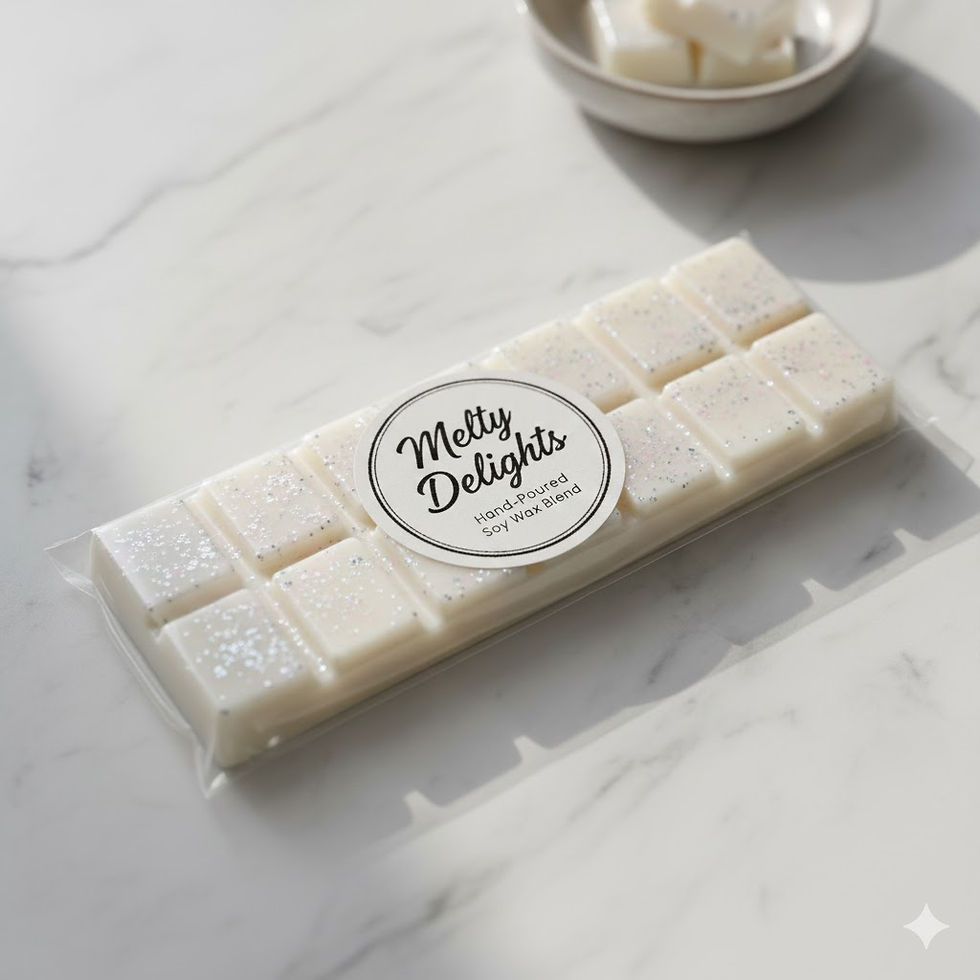
I thought if everyone is selling the same kind of product, then standing out is surely the way to differentiate our wax melts, and attract the wax melt lovers who are sick of the same old products. I know we were!
In a market that can be hugely profitable but is heavily saturated due to low start up costs, blending in, in my opinion, is not going to grow your business.
I knew that if I followed the exact same route as everyone else, my products could drown in the noise, and i would get caught up in a price war with those around me, which would minimise my profit and make it much harder to succeed.
Finding the right Packaging for your product
I started the hunt for suitable packaging and eventually settled on a premium feel cardboard tube. It was different to anything else I had seen anywhere, and would allow us to offer 100 grams of waxmelts to our customers instead of the 35-55 grams a standard wax melt snap bar gives you.

How to Make Your Own Product Labels and help your packaging stand out (Without Spending a Fortune)
Obviously my premium cardboard jars cost more than double what the plastic snap boxes cost and I would have to make almost double the quantity of wax melts to fill it but aside from a very strict bulk buying strategy (a guide for another time) I decided I wanted these tubes too much to dismiss the idea based on cost alone....
The Innovation
I would cut the labels myself on my cameo cutting machine and print them using an eco-ink printer.
You can have unique, professional-looking packaging without spending a fortune. Most guides about product labelling come from the companies that sell the labels, there are very few resources when it comes to actually making your own labels and very little on cost comparisons .
One of the biggest ways to bleed money for this type of craft product business in the beginning, is outsourcing your labels to a label making company. Whether you choose a sole trader vs limited company structure for your new venture, keeping your start-up overheads as low as possible is crucial to surviving your first year.
When you take the time to create your own unique packaging, you can often charge a premium for your products, which takes you away from the race to the bottom way of pricing products, that many generic sellers have as they compete with each other.
This allowed me to hold onto my cardboard jar packaging and turn my product from a generic wax melt to a premium product.
It allowed me to:
Choose a different style of container to everyone else
Decorate those containers for a fraction of the cost
Build a brand that genuinely stood out
Keep my costs low while others were bleeding money
Offer almost double the amount of wax melts for £1.00 more than the cheap plastic packaged wax melts.
Offer my customers 1 months worth of wax melts for £5.00
Below is a photo of my actual wax melt packaging, using printed and cut custom labels made in-house using my cameo cutting machine and eco-ink printer.

Printing your own product labels really is worth it
Most label companies price and sell their labels based on the volume you buy and the size of the label.
This is fine if you sell one product in massive numbers and can get bulk discounts. But most craft businesses don’t work like that, certainly not in the beginning.
For wax melts a typical small maker has:
Multiple scents on offer, selling 1 or 2 products at a time in a couple of different scent options..
Seasonal scents that come in an out of production yearly.
Limited edition products, or special one off scent requests from customers.
Fast turnaround times, customers don't want to wait 2 weeks for the product.
Let’s look at a very normal starting setup for managing your labelling needs:
You offer 5 initial scent options to your customers, which requires 5 label designs.
You find some Circular gloss labels of a size that fits your packaging and order a roll for each scent type. So 5 rolls of up to 100 labels.
You have small orders coming in but need to order a full roll of labels for each scent type.
Ordering from a label maker online usually works out at 40–44p per label.
Now let’s do the maths.
If you sell just 6,000 units per year, that’s a cost of:
£2,640 per year
£7,920 over three years
And if you have 50 or 100 different scents? The costs spiral fast.
That money is gone before you pay for:
Wax
Fragrance oil
Containers
Electricity
Insurance
Marketing
And here’s the key point: Standard labels are a fixed cost that eats your profit without adding value; custom labels increase your value while lowering your costs.
The DIY Label Setup: Real Costs, Real Numbers
By investing once in a small in-house setup (what I call a DIY Label Lab), you can get your label costs down to under 3p each.
One-off setup cost
Eco-Tank inkjet printer - you can pick up for around £130 - £220
Cutting machine - I bought a cameo 4 for under £200.00 (the new cameo 5 is now out)
CorelDRAW Design software - I bought an older version of corel draw outright
Rough total spend : £370 - £460
If you buy a second hand setup just to get going, you can get a setup for under £200.00 and that money will be made back easily with the extra profit you retain.
That’s it. No monthly fees. No minimum orders.
Ongoing label costs (89mm round labels)
£22.80 for 100 A4 sheets
8 labels per sheet
800 labels total
→ 2.85 pence per label
Ink
Ecotank ink cost per label ≈ 0.04 pence
Total cost per label→ Around 2.9 pence
Even allowing for the odd misprint or blade change, staying under 4p per label is completely realistic.
The Long-Term Savings (This Is Where It Really Matters)
Method | Cost per Label | Yearly Cost (6,000 units) | 3-Year Cost |
Outsourced labels | 44p | £2,640 | £7,920 |
DIY printing | ~3p | £174 | £522 |
Savings | — | £2,466/year | £7,398 |
That £7,000+ doesn’t disappear — it stays in your business.
It can help pay for:
A council-backed retail unit in my town of accrington
Bulk buying wax and oils at trade prices
A van or delivery setup
Markets, pop-ups, or advertising
Equipment that increases production
Towards a full time wage
This isn’t theory. It’s simply money you stop giving away, and it's a strategy that has proven invaluable for us.
Agility: Why Small Makers Can Win
In business terms, this is called agility.
When you outsource labels:
You must commit upfront
You must guess demand
You pay for mistakes
You must wait up to a week for those labels to arrive
You have no control over the quality of the labels
Order 100 labels for a scent that doesn’t sell?
100 × 44p = £44 wasted just on one scent alone
With in-house printing:
You can print 8 test labels for 32p
You can trial new scents with almost no risk
You can react fast to changing demands
You can offer 100 scents instead of 5 without having you spend more money on labelling. This increases your chance of a customer buying something with each visit to your stall or shop.
If a scent goes viral on TikTok on Tuesday, you can be selling it on Wednesday — fully labelled and branded.
You can react within a few hours to customer demand and never run out of labels
Big companies can’t move that fast.Small businesses can — if they stay flexible.

Design Control = Real Control
When you print your own labels, design stops being a cost and starts being a tool.
You can:
Change existing scent designs to suit Halloween, Christmas, Valentine’s without having to place a new order and holding even more stock.
Run limited editions
Offer personalised labels (names, messages, gifts)
update compliance info instantly (like making sure your safety data matches our comprehensive guide on CLP labels for wax melts), and keep everything looking consistent.
This lets you:
Charge extra for personalisation
Offer extra value to your customers for minimal cost to you
Try new looks without risk
Build a stronger brand
You don’t need to be a graphic designer — just willing to learn a few basics
Cash Flow: The Silent Business Killer
Most small businesses don’t fail because they can’t sell —they fail because their money is tied up in stock unnecessarily.
Pre-printed labels:
Trap cash
Can’t be reused
Become worthless if designs change
Printing your own labels means:
Cash stays in your bank until something sells
You print only what you need
Your business stays lean
It’s the same principle big manufacturers use — just scaled down for small makers to keep your accounts simple, especially as you look ahead to the new making tax digital 2026 requirements for UK self-employed earners.
Less Waste, Less Stress
Outsourced labels often mean:
Overruns
Excess packaging
Old designs going in the bin
Printing on demand:
Reduces waste massively
Stops unused stock piling up
Fits perfectly with small-batch making
Customers notice this — and increasingly care.
Looking Professional Without Paying Professional Prices
Modern Ecotank printers produce:
Strong colours
Sharp text
Consistent results
With decent paper and clean cuts, the finish:
Looks boutique
Feels premium
Builds trust
Customers assume the labels are professionally printed — because the end result is what matters.
The real win is this:
You look like a big brand while keeping small-business margins.
Final Thoughts
Paying 40p per label isn’t professionalism.It’s an unnecessary cost that slows growth.
Printing your own labels:
Cuts costs permanently
Improves cash flow
Gives you freedom
Helps your brand stand out
Sets you up for long-term growth
Stop being locked into label companies.Start building something that works for you.
Because every 40p you save on a label isn’t just saved money —it’s fuel for the next stage of your business.
Check out our free step by step guide to making your own labels using corelDRAW and the cameo cutting machine. Click this link.
There are plenty of tutorial channels on YouTube if you have a different setup, our setup will show you the exact steps needed to create a product label using a cameo cutting machine and the corel draw software.
Don’t Miss the Next Blueprint
If you found this guide on label costs helpful, there is plenty more coming to The Makers Lab. Check out my handy cutting machine guide if you decide to take my advice and make your own labels.
Comments