Allowable Business Expenses for UK Sole Traders: The Complete Guide

If you're a sole trader or part of a business partnership, you need to register for Self Assessment and submit tax returns. You pay Income Tax on your profits, not your total income.
Profit is your turnover minus your allowable business expenses. Get your expenses right and you won't pay a penny more in tax than you legally owe.
Before we get into it: if you operate through a limited company, this guide isn't for you.
Companies are separate legal entities and claim expenses under Corporation Tax rules. And money you take out of the business for yourself (your drawings) does not count as an expense.
What's in this guide
Stock and materials - what you buy to sell or make your product
Office, tech, and software - day-to-day costs, kit, phones, and broadband
Working from home - how to split your household bills fairly
Travel and vehicles - mileage, fuel, and what counts as a business trip
Clothes, staff, and training - what HMRC will and won't accept
Legal, financial, and marketing - fees, insurance, ads, and what's banned
How your accounting method affects things - cash basis vs traditional at a glance
Keeping your records - what to keep and for how long
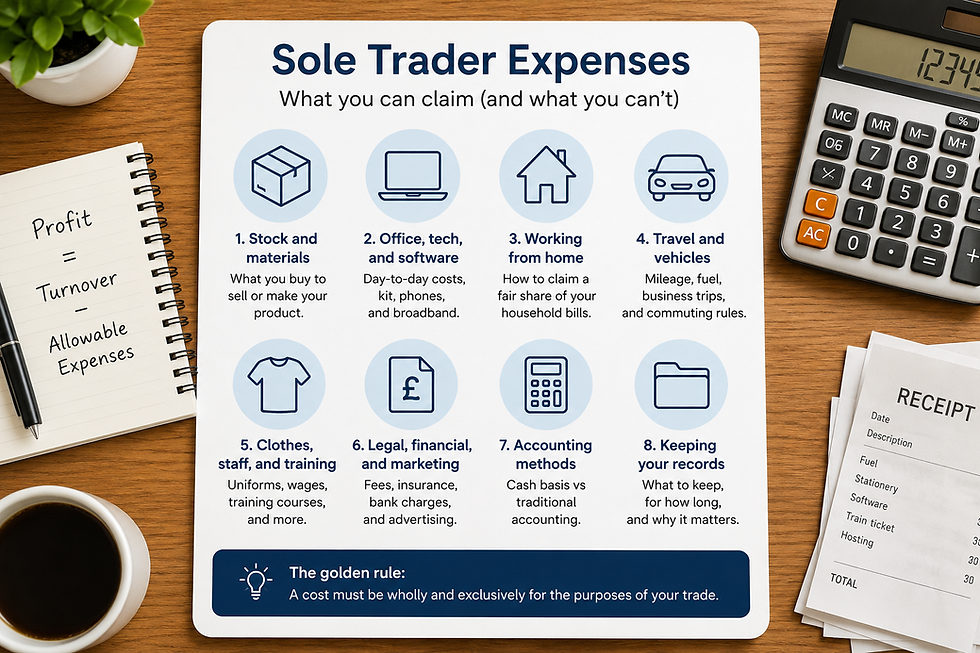
The golden rule
HMRC has one main rule: a cost must be wholly and exclusively for the purposes of your trade.
If something has both a business and a personal use, like a mobile phone contract, work out the business percentage and claim that part. You can't claim the personal chunk.
1. Stock and materials
What you can claim: anything you buy to sell on. Stock, raw materials, and the direct costs of making your goods.
What you can't: anything bought for personal use.
2. Office, tech, and software
Day-to-day costs
Stamps, printer ink, stationery, website hosting, and domain renewals are all claimable.
Tech and equipment
Most sole traders use cash basis accounting. If you do, you deduct the cost of laptops, printers, and software as a normal business expense when you buy them. If you use traditional accounting, bigger pieces of kit may need to go through as capital allowances instead.
Phones and broadband
If you use your personal mobile, calculate the business percentage and claim that. If the business has a dedicated phone line or broadband contract used solely for work, the whole bill is allowable.
3. Working from home
If you work from home, you can claim a portion of your household bills. That covers heating, electricity, Council Tax, rent, or the interest part of your mortgage (not the capital repayment). You have two options.
Actual costs
Work out a fair split. If you have four rooms and use one mainly for business, you could claim a quarter of your utility bills, adjusted for the hours you work. Don't say you use a room exclusively for business, it can cause Capital Gains Tax problems when you sell your house.
Simplified expenses
Skip the maths and use HMRC's flat-rate simplified expenses. You get a fixed monthly deduction based on how many hours you work from home.
If you live at your business premises, like a pub, B&B, or a shop with a flat above it. HMRC has a separate set of flat-rate deductions to strip out your private living costs.
4. Travel and vehicles
What you can claim
Vehicle insurance, repairs, fuel, parking, breakdown cover, road tax, and hire charges. Train, taxi, and plane fares are fine. So are hotel rooms and meals on overnight business trips. Everyday lunches and coffees while working normally aren't allowable unless they're part of qualifying business travel.
Commuting
Travelling from your house to a permanent business base is just a commute. You can't claim it. Driving to a temporary workplace, a client site, or a supplier is fine.
Mileage rates
Instead of keeping every petrol receipt and tracking wear and tear, you can use HMRC's flat-rate mileage scheme. For the 2026/27 tax year the rates are:
Cars and vans: 55p per mile for the first 10,000 business miles, then 25p per mile
Motorbikes: 24p per mile
Bicycles: 20p per mile
5. Clothes, staff, and training
Clothing
You can claim for uniforms, safety gear, or stage costumes. You can't claim everyday clothing, even if you only ever wear it for work. If you could wear it down the pub, HMRC won't allow it.
Staff costs
Employee wages, bonuses, pensions, subcontractor fees, and Employer's National Insurance are all allowable. A personal nanny or domestic cleaner is not.
Training
You can claim for courses that update skills you already use in your business. You can't claim for a course that teaches you how to start a completely different business.
6. Legal, financial, and marketing
Professional fees
Accountant and solicitor fees are fine as long as they're for the business. Your accountant sorting your business tax is allowable. Them sorting a personal tax issue is not.
Insurance
Business policies like public liability, professional indemnity, and contents insurance are fully allowable.
Financial charges
Bank fees, overdraft charges, and interest on business loans or hire purchase agreements are claimable. Paying off the loan itself is not.
Marketing
Directory ads, mailshots, trade journals, and free samples are all fine. Entertaining clients or taking suppliers out for a meal is not.
Pensions
Don't put your personal pension contributions through as a business expense. They're dealt with separately for tax relief.
7. How your accounting method affects things
Under traditional accounting, many assets like heavy machinery can be deducted in full in the year you buy them using the Annual Investment Allowance, though cars have their own rules.
Here's how the two methods handle specific items:
Item | Traditional Accounting | Cash Basis Accounting |
Business Cars | Claim via capital allowances | Claim via capital allowances |
Vans, Bikes, and Tech | Claim via capital allowances | Claim as a standard allowable expense |
Bad Debts (Unpaid Invoices) | Specific bad debts can be written off | Cannot be claimed at all |
The Trading Allowance: you get a £1,000 tax-free Trading Allowance each year. If you use it against a trade, you can't also claim business expenses or capital allowances for that trade. It's one or the other.
8. Keeping your records
You don't post receipts to HMRC when you file your Self Assessment return. You add up your totals for the year and enter the final figures into the form.
You do need to keep your records, invoices, and receipts though. Digital photos are fine. Hold onto them for at least five years after the 31 January submission deadline, in case HMRC decides to run a check.
Not sure whether Making Tax Digital applies to you yet? Use our Making Tax Digital checker to find out.
Tax rules can change and individual circumstances vary. If you're unsure whether an expense is allowable, check HMRC guidance or speak to a qualified accountant.
Frequently asked questions
Can I claim expenses if I'm just starting out and haven't made any money yet?
Yes. You can claim allowable business expenses from the point you start trading, even if you're not profitable yet. A loss can be carried forward and offset against future profits.
What's the difference between an expense and a capital allowance?
An expense is something you use up running your business, like stationery or a broadband bill. A capital allowance covers bigger assets you keep and use over time, like a van or a machine. Most sole traders on cash basis don't need to worry about the distinction — you just claim the cost when you buy it.
Can I claim my phone if I use it for both work and personal calls?
Yes, but only the business portion. Work out roughly what percentage of your usage is work-related and claim that. Don't claim the full bill if it's a personal contract.
Do I need to send HMRC my receipts?
No. You just enter your totals on your Self Assessment return. But you must keep the receipts and records yourself for at least five years after the 31 January deadline, in case HMRC asks to see them.
Can I claim for clothes I wear to work?
Only if they're a uniform, protective gear, or a costume. Everyday clothing doesn't qualify, even if you only wear it for work. If you could wear it anywhere else, HMRC won't allow it.
What happens if I get an expense wrong?
If you've overclaimed by mistake, you can correct it. HMRC distinguishes between honest errors and deliberate fraud. Keep your records tidy and you'll be fine.


Comments