How to Start a Workwear Company: The Supplier-First Sourcing Guide for Garment Decorators

Updated: May 25
If you're researching how to start a workwear company in the UK, this guide is going to save you a lot of time, money and frustration. I've used all four of the suppliers listed below, for years, and they're the ones I built my entire business around when I ran GoTo Workwear Ltd.
The suppliers in this list can provide everything you need, from workwear apparel to fashion brands and accessories, all designed with garment decoration in mind. I recommend ordering a few samples from them to practice on, until you have perfected the art of printing and embroidery. Make your own workwear first, and then you will have some samples to show your potential customers. That's what I did.

If you choose to use contractors for your garment decoration, creating your own workwear is the perfect way to test out their capabilities before trusting them with a larger customer order.
There are other customer upsells we can look into, too, such as PPE (Personal Protective Equipment), Safety Signage, and work-related consumables, all of which allow the potential to scale into a multi-faceted supplier and really compound your potential earnings.
I've briefly touched on PPE in this guide; I will publish a dedicated blog on this topic and other potential products that align well in the future, so stay tuned! The focus today is your core workwear clothing supply chain: the wholesalers who'll let you offer customers a reliable, high-quality, competitively priced workwear supply, containing clothing that can be embroidered or printed with company logo or other designs.
I am passionate about helping people to start their own businesses, and all of the information in this guide is 100% free. I will place the odd affiliate link here and there so that I can keep this content free as my site grows.
I have spent 30 years on the shop floor in fast-paced engineering environments — high-spec aerospace, casting foundries, car parts manufacturing, pneumatics. I have worn many of the workwear garments I later ended up selling every day, through 12-hour shifts in all conditions.
I know what it feels like to work for 12 hours in uncomfortable workwear, I have frozen in winter, been drenched in April and sweated half to death in summer, I have put a lot of the workwear in this guide through its paces personally in several workplace environments, I know what makes a good polo shirt, or pair of workpants!
I also have several years of experience selling all of this workwear and gathering customer feedback, refining my service and you will benefit from all of that experience hopefully.
I hope you find this guide useful, I'm sure you will obtain a huge amount of value from it and it will help you to start off with the best foundation possible using a highly reliable supply chain! One less worry to have is a good thing I can assure you!
My Four Main Workwear Suppliers at a Glance
BTC Activewear — Best for core contract volume, the UCC range, Yoko hi-vis, and decoration-friendly basics
Ralawise — Best for brand variety (Portwest, Scruffs, Pro RTX, Stanley Workwear), webshop integration, and backup PPE
Orn Workwear — Best for premium engineering uniforms, heavyweight polos, and trade trousers
Leo Workwear — Best for premium high-vis, roadside and civil contracts, and technical fabrics
Why I Think Workwear Beats "Fashion Brands"
Most people who want to get into clothing try to launch a fashion label. A high percentage of them fail. In my opinion targeting local businesses (construction, landscaping, hospitality, manufacturing and retail) with workwear, is a completely different, and infinitely better, game:
Zero Trend Risk: A black Uneek polo shirt or a Regatta softshell jacket looks exactly the same this year as it did five years ago. You will never get stuck with "out of style" stock.
Emotional vs. Utility Buying: Fashion customers are fickle and return clothes constantly if the fit isn't "perfect." B2B clients view workwear as a tax-deductible utility. Return rates are practically zero.
The Re-Order Compound Effect: This is the real secret. When a local building firm hires two new lads in September, or their winter jackets get ruined by winter, they don’t shop around. They email you and say, "Can we get 6 more of the same as last time?" A single client secured in Month 1 can pay you predictably for the next three years.
You can hold minimal stock: You can order from these suppliers after you secure an order, meaning you only commit to holding stock once you have a customer for it, this is an ultra lean way to manage stock, and to avoid wasting money.
For a brief article on how and why I built a workwear company and the steps I took then please read How I built a 100k Workwear Business with just £200/month
The Lean Way To Sell Workwear (How it Works)
You don't need to spend thousands of pounds on stock or expensive machinery to get started. I'm going to show you how you can set up from the front bedroom of your house, whilst minimising your manual tasks and focusing on the admin side of your business.
Find yourself a good local embroidery or printing company to do all of your orders for you. Agree prices and set up fees, and then factor this into the price you offer to your customer. Many will offer you trade prices as you increase in order volumes and quantities, and will be glad of the extra work!

Ask your contractor how they require you to send your artwork for logos and designs and they will help you through the process.
Subscribe to, and learn CorelDRAW, or a similar graphic design package, this will allow you to cut costs and is not hard to do. It will prove invaluable to you and your business.
This is how I ran my business:
Step 1: The Sale & Invoice
The Action: Client accepts your competitive trade quote and pays via Pro Forma Invoice. (basically a request for an upfront payment before you deliver anything with clear terms set). You can offer to take a 50% deposit too which meets them half way and mitigates risk for both of you.
The Cashflow: You now have the client’s money in your bank account before you spend a single penny on stock.
Step 2: The Blanks Order
The Action: Log into your trade distributor account (Ralawise or BTC Activewear for example).
The Logistics: Order the exact blank garments required and set the delivery address directly to your local contract embroiderer or printer.
Step 3: The Production Hand-Off
The Action: Find a company online ( I used one based in India) to convert your design into an embroidery machine file, known as a .DST file. Email your outsourced .DST embroidery program file straight to your contractor. Or send them your artwork for printing, designed by you if possible.
Top Tip Many of your customers will have their logos already designed, and will gladly give you the design files, if they have them. Ask for them in PDF format.
The Logistics: The contractor receives the blanks and files, and handles the physical embroidery or printing production.
Step 4: White-Label Delivery
The Action: Once production wraps, the contractor boxes the job. You email them a PDF shipping label.
The Result: The courier picks up the boxes and delivers them directly to your client. The client gets their gear, and your contractor remains completely invisible.
Verify PPE Compliance Before Supplying
Before supplying PPE or safety wear, ensure the products are suitable and properly certified for their intended workplace use. Supplying incorrectly specified or non-compliant products can create compliance and liability risks for both suppliers and customers.
Standards and guidance can change over time. Before quoting or supplying products:
Verify the product carries the correct UKCA or CE marking where applicable.
Review current manufacturer conformity documentation.
Check the latest guidance from the Health and Safety Executive and the relevant product standard.
Confirm the required level of protection with the customer based on their workplace risk assessment.
This information is provided as general guidance only and should not be considered legal or regulatory advice.
Now let's get into the suppliers you should start with.
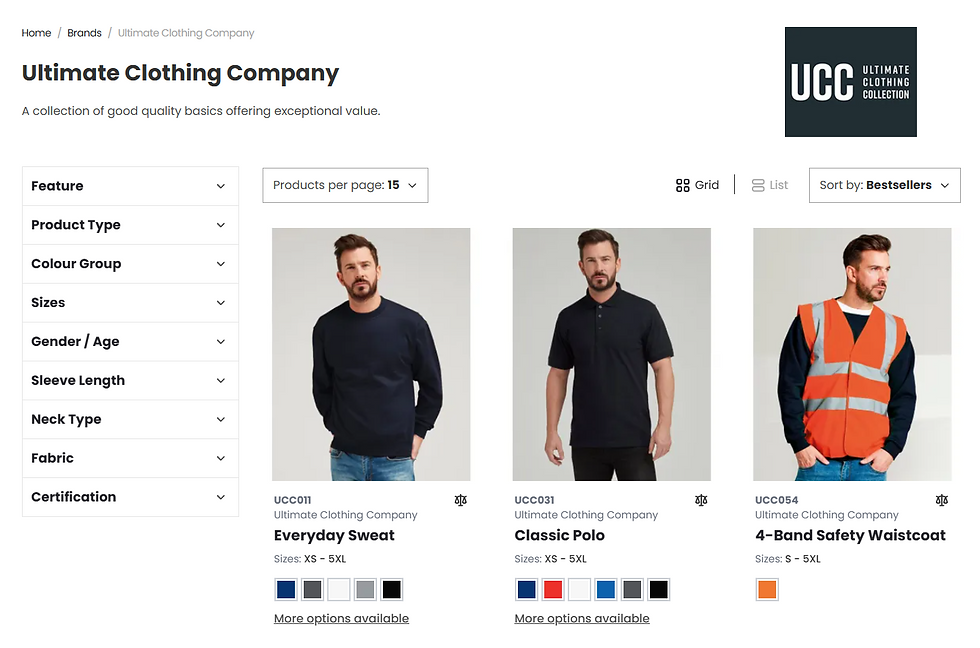
If you want a reliable wholesaler that can handle everything from standard promotional wear to heavy-duty workwear, BTC Activewear will be a core pillar of your supply chain. They give you the stock reliability you need to run your business smoothly, and they give your customers the durability, quality and value they demand.
What They Excel At
BTC has a massive apparel catalogue which is kept up to date live, and contains great brand variety. They carry industry staples that customers ask for by name, like Result, Ultimate Clothing Collection, Jobman, Helly Hansen, Dennys (brilliant for catering and hospitality), Kustom Kit, Bella & Canvas, Regatta Safety Wear, and many other high quality durable workwear brands, ideal for a range of industries and applications.
I have dealt with BTC activewear more than any other company, they have excellent customer service and although I never used their integrated catalogue on my site for ecommerce, I did provide a basket free version for several years on my website. It was a great addition to my business.
My Personal Favourites & Insider Picks
I will now give you some of the brands I used personally when running Goto Workwear Ltd.
When I first got started, I targeted engineering firms. Why? Because I'm an engineer. Thirty years of shop floor experience across high-spec aerospace, safety-critical valves, car parts manufacturing and pneumatics meant I didn't just know how to sell workwear — I knew what my customers and their employees actually felt like wearing it for a 12-hour shift.
You aren't just selling a garment. You are selling their team's comfort and safety, and you are also helping the company to maintain a professional, responsible image.
If you want to supply the engineering and manufacturing industries, you need to recommend a 50/50 poly-cotton blend. It's the absolute king of the shop floor and one of the most supplied and trusted styles in the entire workwear trade for good reason. Poly-cotton offers excellent moisture-wicking properties, pulling sweat away to keep workers comfortable. 100% cotton is great for pure summer comfort, but it doesn't always hold up to the mechanical punishment of a machine shop or construction site. So choose thicker materials when possible.
When you're sourcing from BTC, look straight at their Ultimate Clothing Collection (UCC) range. Tough as old boots, entirely unisex (which makes inventory a breeze), and crucially for decorators — the fabric embroiders, prints, and takes DTF transfers beautifully without puckering or scorching. It is built to last and your customers will love the value it provides (mine did).
Here's exactly how I structured seasonal offerings to engineering clients using those blanks:
Summer Setup — UCC003 Lightweight Polo A 180gsm 50/50 poly-cotton polo. Lightweight, breathable baseline option. Swap in Fruit of the Loom 100% cotton if the client insists on all-natural fabric, or works in a light production environment. I found outdoor workers in summer loved 100% cotton T-shirts and polos.
Autumn/Winter Setup — UCC031 (Men's) / UCC003F (Ladies') A solid 220gsm poly-cotton blend that blocks the chill while keeping the team looking sharp. Really useful for heavier wear environments.
Premium Heavyweight — UCC004 Premium Polo A massive 240gsm tank-built garment for maximum durability. Note: some colours are being phased out presently.
Skip the cheap, unrated rubbish that loses its retroreflective backing after two washes. Use BTC to source the Yoko and Delta Plus ranges. Their fabrics are incredibly stable and print exceptionally well for heat transfer printing (HTV) and DTF without cracking or lifting on heavy polyester. I particularly recommend using STAHLS Sportsfilm Extra Heat Transfer Vinyl for printing if you can, it's a durable material that will not crack when stretched, after application.
Here are my go-to's:
Yoko Enhanced Vis Waistcoat (HVW100EV) — Bread and butter of site safety. 5cm reflective tape and an excellent flat surface across the back and left chest for flawless HTV and DTF application.
Yoko Hi-Vis Reversible Fleece Vest (HV008F) — A brilliant premium upsell for supervisors. Holds transfers tightly on the hi-vis side and handles embroidery beautifully on the fleece side.
Yoko Hi-Vis Multi-Function 7-In-1 Jacket (HVP711) — The "white whale" item for site managers and civil firms. A technical beast adaptable for any weather.
TOP TIP Hi-vis vests are typically made from 100% Polyester. When Heat transfer printing logos onto them. Use a lower heat setting towards 135 or 140 degrees for 5 to 7 seconds on a firm pressure, with the Sportsfilm Extra Heat Transfer Vinyl from STAHLS. The recommended heat setting of 150 degrees can crinkle the thin polyester fabric, if applied too hot.
2. Ralawise

Ralawise are another highly reliable and capable giant of the UK workwear and apparel market, and have a range filled with high quality respected brands and can deal with high quantities just as well as BTC Activewear. In many respects they are similar, but Ralawise seem to be the larger of the two companies, certainly by Brand coverage.
What They Excel At
Brand variety and marketing tools. Access to top brand names like Pro RTX, Portwest, Stanley Workwear, Scruffs, and Regatta Professional.
On top of that they offer a feature called "Your Web Shop" — for a monthly fee, it's an embeddable, live product catalogue that acts as your own fully functional website, complete with a personalisation tool. I used this service and it added tremendous value to my own website, and saved me thousands in website development fees.
BTC has caught up significantly and offers a brilliant webshop option too — worth exploring — but I leaned toward Ralawise for its user functionality towards the later years of my business.
A word of warning on those webshops though: they come pre-loaded with standard retail pricing matrices straight out of the box. Don't just plug it in and go live. You need to properly configure your margins, decoration setup fees, and minimum order rules before you start taking orders — otherwise you can end up selling a single decorated polo at a loss because the platform didn't account for your screen printing setup or DTF transfer costs.
My Personal Favourites & Insider Picks
Trousers are the most abused garment in any uniform. If you supply engineering or maintenance teams, you need a good range of options for use across many work environment types.
Entry-Level Standard — Portwest Preston Trouser (PW105) A basic, highly affordable, dead-reliable workshop trouser. Clean poly-cotton with standard pockets. In my experience, suitable for machine operators or inspectors for example, relatively light working environments.
First Upgrade — Pro RTX Pro Cargo (RX600) Two front pockets, side cargo pockets, and integrated knee pad inserts for a tiny price jump.
Heavy-Duty Trade Standard — Portwest Action Trouser (PW101) A legendary industrial trouser packed with multi-zipped pockets and heavily reinforced fabric at the seat and knees.
Maintenance Specialist — Scruffs Worker Trouser (SH056) Tough lightweight twill with Abratect knee pad sections. Step up to the Worker Plus (SH054) or Trade Holster (SH028) if they need external holster pockets.
Popular Workwear, Jumpers & Hoodies
Pro RTX Pro Polo (RX101) & Pro Sweatshirt (RX301) — Robust competitors to BTC's UCC line. Heavyweights (220gsm polo / 300gsm sweatshirt) with 60-degree wash tolerance to shed grease and machine oils. Both take DTF transfers cleanly.
Pro RTX Pro Hoodie (RX350) — A solid 300gsm heavyweight hoodie that keeps a stiff, professional profile.
Premium Upsells (Russell & Regatta) — The Russell Authentic Hoodie (R-265M-0) has a legendary flat face that takes fine-detail heat transfers and DTF beautifully without stretching under the press. Pair with Regatta Thor Fleeces for mid-layer choices.
3. Orn Workwear

If you want a supplier that's perfectly aligned for trade uniforms for use in an industrial setting, Orn Workwear is the peak of the market. I've worn Orn gear personally — it feels genuinely premium and competes perfectly with the very best equivalent ranges out there.
When I ran GoTo Workwear Ltd, Orn became a deeply trusted supplier. They had everything I needed to kit out factories with their basic workwear needs all in one place.
What They Excel At
Orn garments are structurally built for severe industrial abuse. Fabric stability, heavy-duty stitching and deep colour-fastness mean garments won't stretch, shrink or fade into a dull grey after five industrial washes.
That stability is also what makes them gold for decoration. Tightly woven, dimensionally stable fabric is exactly what you want under a heat press — DTF transfers sit flat and bond properly, HTV doesn't lift at the corners, and embroidery applies easily without tearing the fabric.
Their polo shirt range is genuinely excellent. The Orn Eagle Polo Shirt is a masterpiece — if you're looking for the perfect alternative to the discontinued heavyweight UCC004 from BTC, the Eagle is your exact answer.
My Personal Favourites & Standout Picks
Eagle Productive Polo Shirt (1160) — The flagship. Triple-stitched seams and a fully padded neckline for pure comfort during a 12-hour shift. Your definitive premium heavyweight polo.
Hawk Polo Shirt (1130) & Condor T-Shirt (1000) — High-volume winners. The Hawk handles left-chest embroidery flawlessly; the Condor is a proper heavyweight tee built to survive a machine shop.
Merlin Sweatshirt (2100) & Osprey Hoodie (2200) — Built for the winter chill. Robust with soft brushed fleece linings that maintain a professional profile without looking slouchy.
Silverswift Softshell Jacket (4200) — An incredible windproof and water-resistant technical layer for site managers and drivers.
Falcon Combat Trouser (2500) & Harrier Holster Trouser (2600) — The jewels in Orn's crown. The Falcon features top-loading knee pad pockets and heavily bar-tacked stress points. The Harrier adds heavy-duty external holster pockets. Both easily beat the competition for comfort and durability.
Buzzard Cargo Shorts (2700) — The exact same rugged configuration as the full trousers, giving factory teams relief in the summer.
4. Leo Workwear
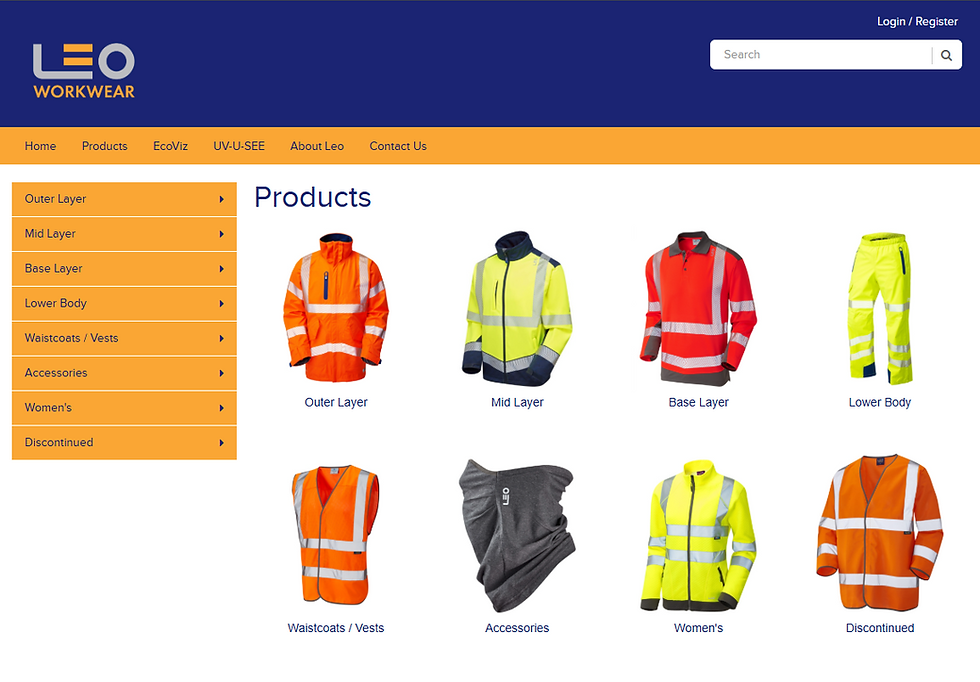
When you're dealing with premium clients, standard catalogue hi-vis just doesn't cut it. I learned this firsthand when I got orders for Yorkshire Pro Paving — when you've got lads laying high-end stone, working 12-hour shifts in miserable weather right on the roadside, they need gear that keeps them safe, visible and comfortable.
That's why Leo Workwear became my absolute go-to for premium high-vis. Based in Devon, Leo have been specialists in high-vis and PPE for over 40 years.
What They Excel At
Leo tackles the standard "sweat-box" hi-vis problem head-on with proprietary fabrics that bridge the gap between heavy-duty protection and athletic performance:
CoolViz & COOLMAX® — Engineered for moisture-wicking and UV protection (UPF 40+). Mesh ventilation panels under arms and side seams pull sweat away during heavy manual lifting.
EcoViz® — The sustainability heavyweight. Made entirely from recycled post-consumer clothing and plastic bottles. More than half the EcoViz range is certified to 50 wash cycles, above the industry standard.
LTEC 20K — Used in their high-end waterproofs, pushes the boundaries of water resistance and breathability.
Retromax+ Stretch & Segmented Tape — Instead of rigid, solid grey bands that restrict movement and crack, Leo uses segmented chevron reflective tape that stretches with the fabric.
A quick note for decorators: hi-vis is high-polyester territory, and that means decoration choice matters. Low-temperature DTF films and quality HTV designed for polyester are the safe options. Standard high-temperature vinyls will cook hi-vis fabrics and cause dye migration straight through your transfer — a beginner mistake that loses customers fast.
Incredible Sales & Technical Support
You cannot afford to guess what you're doing when you're dealing with critical safety wear.
When I needed to sort kit for Yorkshire Pro Paving's roadside needs, I could pick up the phone, explain exactly what environment the lads were going into and alongside my own knowledge, Leo's support team helped me match the customer to the exact hi-vis spec required. You finish that call 100% confident the gear you're decorating is right for the job.
My Personal Favourites & Standout Picks
Premium Base Layers (Braunton T-Shirt & Georgeham Polo) — Generous fit with inherent stretch, contrast collars to hide dirt, segmented tape. Don't shrink or warp.
Heavy-Duty Work Trousers & Joggers (Bideford Cargo & Kingford Stretch Cargo) — Reinforced construction, triple-stitched main seams, quadruple-stitched reflective tape.
High-Performance Outerwear (Torrington Bodywarmer & Marwood Anorak) — Articulated sleeves so the coat doesn't ride up when lifting; bodywarmers come with warm quilt linings.
Inclusive Safety Gear (Women's Hi-Vis Range & Pippacott Polo) — Genuine, certified ladies'-fit safety gear. A massive selling point when pitching to modern construction or civil engineering firms.
Why You Should Never Depend on Just One Supplier
One of the biggest rookie mistakes in this industry is trying to run your entire business through a single wholesaler. Sounds fine in theory — until stock disappears. And eventually, it will.
You'll quickly discover that:
Certain colours vanish seasonally
Popular sizes sell out unexpectedly
Manufacturers discontinue lines
Delivery delays happen
Brands suddenly change fits or fabrics
If you only have one supplier relationship, your entire production line can grind to a halt. That's why these four suppliers work so well together. They overlap just enough to protect you when problems happen, but each has clear strengths that make them valuable in different areas of the market. That balance is what allows you to scale safely.
Mistakes That Cost You
A quick reference list of the things to avoid when you're starting out:
Relying on a single supplier for everything
Chasing the cheapest garment every week instead of building stable accounts
Selling unrated hi-vis to roadside or civil contractors
Ignoring fabric weight (gsm) when quoting — 180gsm and 240gsm are completely different products at completely different price points
Forgetting that decoration quality depends on fabric stability, not just garment cost
Failing to get sample garments before committing to a bulk customer order
Going live on a "Your Web Shop" platform without first configuring your margins, setup fees and minimum order rules
Forgetting carriage fees when quoting small jobs — see the FAQ below
The Unit Economics: A Real 50-Garment Trade Order
To win contracts with local firms, your pricing has to be competitive. You aren't charging retail prices. This model thrives on volume, low overheads, and high-speed fulfillment. Here is the exact economic breakdown of a standard 50-polo shirt company order, using precise industry trade costs (excluding VAT):
Expense / Revenue Item | Cost Per Unit | Total for 50 Polos |
Blank Trade Polo Shirt (Wholesale distributor cost) | £2.95 | £147.50 |
Outsourced Digitising Fee (One-time setup via India) | — | £8.00 |
Contract Embroidery Cost (Trade partner rate per logo) | £1.00 | £50.00 |
Inbound/Outbound Shipping (Bulk box courier rate) | — | £12.00 |
Total Net Production Cost | £4.35 | £217.50 |
Competitive Selling Price (Mid-range trade quote) | £8.50 | £425.00 |
NET PROFIT | £4.15 | £207.50 |
Net profit per order: £207.50 — a 48.8% margin
Don't Forget About Wastage: You can't resell custom embroidered workwear if it doesn't fit the client or gets eaten by an embroidery machine running at 1,000 stitches a minute. Protect your margins by embroidering a sample logo first for physical approval, and provide blank sizing samples to your customer before ordering in bulk. This completely eliminates guesswork, slashes waste, and most of the time, those same samples can simply be decorated and used as part of the final order anyway.
The VAT Advantage: Because you are VAT-registered, you claim back the VAT on your blanks and setup costs, keeping your buying prices exactly as listed above. Your client receives a standard VAT invoice, meaning the true cost to their business is just the £8.50 per shirt.

FAQ: Starting a UK Workwear Business
Do I need a trade account to buy from these suppliers?
Yes. All four operate on a trade-only basis. You'll need to register your business — sole trader registration with HMRC is enough to get started, you don't need a limited company. Each supplier has its own application form on their website.
What's the minimum order quantity?
There's generally no minimum order quantity on individual garments with any of these four — you can order one piece if you want to. Pricing tiers kick in at higher volumes, so the more you buy, the cheaper each unit gets.
What about carriage and delivery fees — are they really that important?
Yes, and this is the trap that catches almost every beginner. Wholesalers typically charge between £5 and £9 for delivery unless you hit a "carriage paid" threshold (usually around £150 to £200 per order). If you order a single replacement polo at £4.50 to fix a decoration mistake and pay £7.50 in carriage, your margin on that whole job is gone. Always batch orders to hit the carriage threshold where possible, and factor delivery costs into every quote you give.
Which supplier is best for someone just starting out?
BTC Activewear and Ralawise are the best entry points. Both cover huge product ranges and have strong support for new accounts. They have the stock levels and service to ensure you can always get what you need.
Can I open all four trade accounts as a new business?
Yes, and you should. There's no cost to open the accounts, and having all four ready means you can quote any job that comes in without scrambling for stock.
What's the difference between poly-cotton and 100% cotton workwear?
Poly-cotton (usually 50/50 or 65/35) is more durable, dries faster, holds colour better through industrial washes, and wicks moisture better — making it the standard for engineering and manufacturing environments. 100% cotton is more breathable and feels softer, but shrinks more, wrinkles easily, and doesn't survive heavy industrial use as well.
Do these suppliers offer next-day delivery?
All four offer next-day delivery on stocked items if you order before their cut-off times. Always confirm stock levels and delivery times before promising a customer.
What about samples before I commit to a customer order?
All four offer sample garments, you will need to check with them for their individual offerings, but I usually had the restocking fee waived when returning samples, so long as they were not embroidered or printed. Always order samples before committing to a large customer order — you need to feel the fabric, test the decoration compatibility, and verify the sizing for yourself, also it can help you to win orders when offering your customer the chance to see and feel the garments.
Do these garments work with DTF transfers?
Many of them do and DTF is now a viable method for decorating complex logos on workwear. The stable, tightly woven fabrics from all four suppliers handle DTF beautifully. The main thing to watch is hi-vis polyester: use low-temperature DTF films and decoration-compatible vinyls to avoid dye migration ruining your transfers.
The First 14 Days: Your Step-by-Step Execution Map
If you've never printed a t-shirt or opened a trade account, it can feel a bit overwhelming at first, here are a few steps to follow when starting up.
Week 1: Setup & Groundwork
Day 1 Learn the two terms that matter. A Contract Decorator is just a local embroidery or print shop that lets you use their commercial machines for a trade fee. A .DST file is the digital embroidery format the machines read. You don't create this yourself — you can pay an expert around £8 to convert a standard JPEG logo into one. There are many companies globally who can do this for you, so take your time finding one first. I found a company in India called Digitize this, they were brilliant.
Day 2 — Open the Trade Gateways Apply for trade accounts with Ralawise and BTC Activewear first. Don't worry if your website isn't fully built yet — just show them you're a registered UK business or sole trader setting up a garment supply company.
Day 3 — Pick ONE Industry Do not try to sell to "everyone." at first. Pick one industry until you find your feet. Start by targetting small teams. Construction, landscaping, or local mechanical engineering firms are perfect for your first customers, and these suppliers will be able to provide exactly what you need to serve them. Better to fail small if you are going to, whilst building and refining your service.
Day 4–5 — Build Your Core Bundle Offer Create a simple one-page document or image showing a fixed-price bundle. Beginners buy bundles because it removes the guesswork.
Example — The 5-Man Trade Bundle: 15 x hardwearing polo shirts, 5 x hoodies, 5 x Regatta softshell jackets. All including free front logo setup and embroidery. Come up with a competitive price that allows you to make enough profit for your time.
Week 2: Outreach & Real-World Friction
Day 6–7 — Build Your Hit List I used LinkedIn, google and Yell, when first starting out. I drew up a list of local companies to target and then committed to emailing and messaging them daily, with an outline of our service and examples of the kinds of prices I could offer.
Day 8–10 — Send the Soft-Pitch Send 10-20 emails and messages a day. The trick is to research each business before you email — check their website, their Facebook, what kind of work they do — then tailor the message to suit them. Generic mass emails get binned; tailored ones get replies.
Your only goal is to get them to reply with "Yeah, send over a catalogue/pricing." Don't try to close the sale in the first email.
Here's a soft-pitch template you can adapt:
Subject: Workwear for [Their Company Name] — quick idea
Hi [First Name],
I run (your company name) — we kit out trade and engineering firms across [Your Area] with branded workwear that actually lasts.
I noticed your team working on [reference something specific — a recent project, a LinkedIn post, a job shared on Facebook]. Looks like exactly the kind of work where decent workwear matters.
We supply the full range — polos, hoodies, softshells, hi-vis and trade trousers — all branded with your logo, priced for trade volume, and built to survive a proper shift.
Example pricing on a garment you'll know: [Insert a recognised garment they likely already use, with volume tiers — e.g. "Regatta Honestly Made Softshell, embroidered with your logo: £24 each (1–9), £21 each (10–24), £19 each (25+)."]
Two easy options if you're interested:
Reply and I'll send a free no-obligation quote tailored to your team
Drop me a time and I'll pop over for a quick chat
Either way, no pressure — just thought it was worth a hello.
Kind Regards,
[Your Name] — [Your Position] [Company Name] [Website] · [Facebook] · [Phone] · [Email]
Keep it short. Mention something local or specific so they know you've actually looked at them. Offer them a mock-up of their design on a polo shirt — it's the hook.
Day 11–12 — The Mock-Up Win When a lead replies with interest, grab their logo from their Facebook page or website. Send it to your outsourced designer to get cleaned up, or design it yourself, then send the client a visual mock-up of their logo on a premium workwear jacket or polo shirt. Seeing their own brand on a high-quality garment makes the sale ten times easier.
Day 13–14 — Secure the First Order Take a deposit up front or deal pro forma for new customers. Log into your Ralawise or BTC account, order the blanks, route them to your local contract machine shop, and you're live.
Expect To Run Into Problems
Spoilage rates. Commercial embroidery machines run at 1,000 stitches a minute. Very rarely, a machine eats a polo shirt or ruins a logo. Don't panic — standard trade practice is to order 1–2 extra blank garments on large orders, just in case.
Samples. Don't forget what we mentioned earlier: protect your margins by embroidering a sample logo first for physical approval, and provide blank sizing samples to your customer before ordering in bulk. This eliminates guesswork, slashes waste, and most of the time, those same samples can simply be decorated and used as part of the final order anyway.
Lead times. Good contract embroiderers and printers are busy. Tell your customers to expect 7–10 working days from the moment they pay. Never promise next-day delivery on custom embroidered gear. Make sure you confirm a date with your contractor too and track progress. Get them to send you a sample photo to forward to your customer when possible too.
Final Thoughts:
Growing a sustainable workwear brand isn't about chasing the absolute cheapest garment. I always focused on providing my customer with true value. I asked myself, what do they need and what can I get that fits into their price range and usage needs. I would always offer a basic range, a better range, and a best range. This gives them the power to decide how much to spend and to understand the benefits of each range, and maximised my chance of a sale. Listen to your customer and take the time to learn about your product ranges. This allows you a degree of flexibility when quoting orders. Your product knowledge is key to making a sale.
Printing and embroidery differs in price, so offer your customer both options and explain the merits of both methods. Typically larger designs should be printing to reduce cost. (Such as a large back logo design)
By using these 4 suppliers, you will have a great foundation to build your business on, and you will have the confidence to really push your sales without worrying about stock running out, while providing some of the best workwear garments in the industry.
Pick your core niche, open your trade accounts, and start building.
Have you had experience with any of these four suppliers, or are you trying to choose your very first one? Drop a comment below and let's talk shop.

Comments