How To Build A Workwear Business From Your Spare Room

Updated: Jun 25
Have a scroll through Reddit and within five minutes you'll spot someone asking what side hustle they could start from home for a bit of extra money. Most of the answers are the same old ideas: flipping items on Vinted, freelance writing, drop shipping the latest trending item on eBay. I want to give you something a little different. Here's one that works and scales. It's a workwear business, and you can start it from your spare room, as I did successfully back in 2015.
It won't make you rich overnight and it's not an easy ride. But it's a proven way to build something worthwhile from nothing, provided you've got the time, the work ethic, and the determination to see it through.
I know it works because it's the exact template I used to build Go-To Workwear Ltd.

My Story: From eBay Side Hustle to £100k Quotes
Before workwear, I was retail flipping casual clothing on eBay. It made okay money, but constantly hunting for stock and selling single £20 t-shirts was an absolute grind.
Then the penny dropped: What if instead of selling one t-shirt to a hundred individuals, I sold a hundred t-shirts to one business?
That was the start of my B2B workwear business. I began by simply targeting local firms and trades I felt comfortable talking to. You don't need deep industry knowledge or years of experience to do this, just common sense and a lean business model. Using that approach, I grew a £200 starting budget into a business that eventually quoted on major contracts worth up to £100,000.
Those larger deals took time and relationship-building, of course, but the basic blueprint to get there is the same as the one I’m giving you.
Why I Picked Workwear Over Fashion
Workwear Doesn't Go Out of Fashion: A black polo shirt or a softshell jacket looks exactly the same this year as it did five years ago. You never get stuck with "out of style" or "seasonal" stock.
Returns Are Rare: Fashion customers return clothes if the fit isn't "perfect." You can give B2B customers sizing samples so that they can order the exact sizes they need.
Businesses Re-Order: They order items continuously, every time they have a recruitment drive, and typically every year they refresh their workwear. Many companies allow their employees to order new workwear once a year for free, so if you tell them you can give a discount for bulk orders, it prompts them to go around their full team and make a list of multiple items before submitting an order. This also allows you to activate your own suppliers bulk buying discounts and amke the order more profitable.
What Counts as Workwear
Workwear is any clothing worn specifically for work. Whatever line of work you're in, you've almost certainly worn some form of it:
Factory floors: Rugged trousers with enough pockets to carry tools and the freedom of movement to use them, plus full boilersuits that keep whatever's underneath clean during the messy jobs.
Shops and hospitality: Branded polo shirts with a subtle logo that mark staff out as a team, alongside the dark trousers and crisp shirts that customer-facing roles tend to need.
Outdoors and on the roads: Heavy-duty, insulated jackets built to cope with rain and cold through a long shift, plus hi-vis trousers and vests that keep anyone working near traffic visible.
Offices: Ranges from full suits and crisp shirts for client-facing roles right through to the chinos, knitwear, and unstructured blazers that most workplaces have settled into as smart casual.
Charities and community groups: Cheap cotton t-shirts carrying a big logo for fundraising days, fleeces to keep volunteers warm outdoors, and simple tabards so the public can tell staff and volunteers apart at a glance.

What You Actually Need to Get Started (2026 Costs)
You don't need to spend £10,000 on commercial machinery to get started. By using contractors and wholesale clothing suppliers initially, you can grow your customer base slowly, and invest in more and more advanced equipment, eventually bringing all of your production in-house as your business grows. This in turn makes you more profitable in the long run as you scale.
Suppliers of Workwear Blanks and PPE
If you rely on one supplier, your business grinds to a halt when stock disappears. These four work perfectly together:
BTC Activewear: My core pillar. Their Ultimate Clothing Collection (UCC) range is tough as old boots.
Ralawise: The brand giant. They stock Pro RTX and Portwest, and offer an incredible "Web Shop" feature that embeds 80,000 live products directly onto your £20/month Shopify site.
Orn Workwear: The industrial heavyweights. Their garments are built for severe abuse and provide incredibly stable fabrics for heat pressing.
Leo Workwear: The hi-vis specialists. When quoting roadside paving crews, skip the cheap vests and use Leo's moisture-wicking CoolViz gear.
Insider Hack: To find even more suppliers, search online for the "Printwear & Promotion Live exhibitor list". Every major European garment supplier, transfer maker, and embroidery service is right there. One list gives you access to an entire industry's supply chain.
Service Providers for Garment Decoration
An embroidery digitiser: Will create embroidery files for you to give to contractors using your design files. Insider secret: I used a company in India for my digitised program files—the same supplier many UK contractors use. It cuts out the middleman markup and means you can offer low setup costs on even small orders.
An embroidery and printing contractor: Will complete all of your embroidery and printing orders. You just send them your blanks ready to decorate, direct from your wholesale clothing supplier.
Stahls UK: Will produce full-colour heat transfers for you to apply to garments yourself when it makes more sense, and when it is more profitable for you to print logos yourself. You can order a wide variety of heat transfers from them, and they offer a variety of formats for all uses.

Initial Hardware & Software

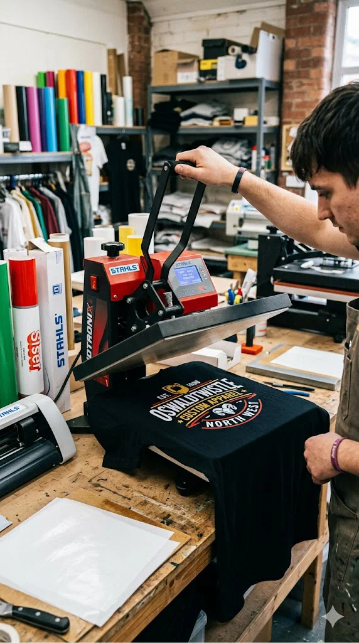
Heat press: For simple heat transfer prints on items such as high-vis vests. Go for at least 38cm by 38cm (though 50cm by 40cm is better). Expect to pay £150–£450.

Vinyl cutting machine: For cutting vinyl transfer for simple logos. A CriCut Explore 5 runs at around £270.00

Website: Shopify's Basic plan is £19/month (billed annually) or £25/month. Many tutorials are available for free online; you can also use AI to help plug your skills gap.

Accounting software: Xero's Ignite/Starter package is £15–£16 a month. This will allow you to automate your accounts, freeing your time up to win more orders.

Card reader: PayPal's Zettle costs about £29 (plus transaction fees) for taking in-person payments. Ideal for visiting companies and taking payment on the go.
Legal & Admin
Limited Company Registration: Setting up formally protects your personal finances. The standard digital registration with Companies House now costs £100.
Accountant: I paid around £900 a year and highly recommend using one initially to ensure your tax returns and Making Tax Digital compliance are perfect, and you are running your business in a tax-efficient way. They say a good accountant will always pay for themselves.
Virtual office space: £30–£40 a month. This gives you a professional address so clients assume you have commercial premises. It also gives you somewhere to meet customers, have your post delivered, and in many, you get a receptionist who will take calls on your behalf. Pro tip: Put a photo of the virtual office building on your website's contact page. Customers assume you have premises, giving you instant credibility.
Public liability insurance: £10–£20 a month (I use Simply Business). This protects your business and your customers and is relatively inexpensive.
The Real Numbers: Fixed Monthly Outlay
By running an asset-light model, your fixed costs are tiny. Here is what it actually costs to run this infrastructure:
Expense | Monthly Cost |
Virtual Office (address, phone, mail) | £40 |
Shopify Subscription | £25 |
Accounting Software | £16 |
Phone/Internet (business proportion) | £20 |
Public Liability Insurance | £15 |
Miscellaneous (samples, fuel for meetings) | ~£50 |
Total Fixed Monthly Costs | Under £170 |
Everything else—blanks, decoration, packaging—is a variable cost tied to actual orders. No orders? Minimal costs. This is the power of a lean startup.
The Asset-Light Workflow & Unit Economics
You don't need a warehouse. You use contractors. You take payment upfront via a pro-forma invoice, and order the stock only when the cash is in your bank.
Margins vary depending on garment choice, logo size, embroidery stitch count, and contractor pricing, but a typical order might look something like this:
Expense / Revenue Item | Cost Per Unit | Total for 50 Polos |
Blank Trade Polo Shirt | £2.95 | £147.50 |
Outsourced Digitising Fee (One-time) | — | £8.00 |
Contract Embroidery Cost | £1.00 | £50.00 |
Bulk Box Shipping | — | £12.00 |
Total Net Production Cost | £4.35 | £217.50 |
Competitive Trade Quote (Sale Price) | £8.50 | £425.00 |
NET PROFIT | £4.15 | £207.50 (48.8% Margin) |
You quote a competitive £8.50 to the client. They get a great trade price, and you pocket over £200 net profit without touching a sewing machine.
How to Actually Get Customers (The Golden Rules)
The biggest mistake beginners make is focusing entirely on what heat press to buy and ignoring how to make their first sale. Building the infrastructure is easy; getting sales requires consistent effort.
1. Who to Target
Do not try to sell to "everyone." Start locally and pick industries you understand. Target:
Local engineering and manufacturing firms - pick smaller businesses first torefine your service, we started with a local mecahnice garage who had several employees only.
Construction and landscaping crews (builders, electricians, plumbers) We supplied yorkshire pro paving, and Leo Workwear was perfect for thier high vis workwear requirements.
Hospitality (pubs, cafes, restaurants) We actually secured our biggest client in this area supplying Cruise First in Manchester.
Local charities, sports clubs, and schools, I actually used my contacts within Blackburn hospital to supply thier childrens ward staff with hundreds of Teddy bear hoodies.
2. The Outreach Strategy
I spent three years visiting SMEs in person, cold calling, and door knocking. There is no shortcut. I used LinkedIn, Google, and Yell to build a "Hit List" of local companies.
Send 10–20 tailored emails or messages a day. Generic mass emails get binned. Check their Facebook page, see what project they just finished, and reference it. Your only goal is to get them to reply with, "Yeah, send over some pricing." Make sure you tell everyone you know what you are doing, this will lead to orders from unexpected places, I once printed 2000 Jute bags on an order I got from someone I worked with, as his Partner ran a local wellness company.
If you have a passion for providing a great service it will come through when you talk to people and it will definately help you to win orders.

3. The Mock-Up Strategy (The Ultimate Closer)
This was the tactic that generated the most of my early sales.
When a lead replies with slight interest, do not just send a boring price list. Instead, grab their logo from their website or Facebook page. Clean it up (or pay an outsourced designer £5 to do it), and create a high-quality digital mock-up of their logo sitting on the left chest of a premium jacket or polo shirt.
Send it back with a simple message: "Thought you might like to see how the new Regatta softshells would look with your branding."
Seeing their own brand on a high-quality, professional garment shifts the conversation from price to emotion. It makes the sale ten times easier.
Put a simple price break table for bulk ordering in there too so they can see the kind of prices you are offering and then they have all the info they need to make a decision.
If you feel like it's worth it, offer to send them a free sample and produce a more extensive quote for them with all the items they are likely to need.
This strategy really worked for me.
One Mistake I Made Early On
One mistake I made early on was spending too much time online chasing sales and not enough time speaking to potential customers in person. Looking back, I should have got out there speaking to people at networking events, and spread the word amongst my close circle much sooner than I did. Once I started getting out and talking to people, my sales really picked up. I then started posting case studies for some of these orders on my socials and encouraged customers to leave reviews, and it gave us real credibitlity. Word of mouth is a game changer in the early days of your business.
Getting the VAT and Financial Side Right
I registered for VAT voluntarily from an early stage because most of my B2B customers were VAT-registered businesses and expected it, but it's worth discussing your own circumstances with an accountant first.
When you do register, you can claim the VAT back on your blank garments and contractor fees. Using Xero and a Zettle card reader means your invoices, bank feeds, and payments all sync up automatically, keeping your accountant happy and ensuring you are perfectly in line with Making Tax Digital.
Scaling the Business
Once you've outgrown the spare room setup and have the cash flow to bring production in-house, you need a different strategy to scale. You stop hunting for single-van tradesmen and start targeting larger organisations, group companies, and government contracts.

Tendering for Public and Corporate Contracts
Local councils, NHS trusts, and large government bodies don't buy workwear by replying to an email; they put out public tenders. You need to monitor platforms like the UK Government’s Contracts Finder and Find a Tender service. These portals list public sector contracts that can secure your business for three to five years at a time. It requires submitting formal bids, demonstrating strict quality control, and proving financial stability—but landing just one can transform your business. For private sector group companies, you will want to get registered on corporate procurement portals.
If you are wondering how you cash flow a £100,000 order without a massive bank loan, the secret is supplier partnerships. On large opportunities, my suppliers were willing to go halves with me on the stock and gave extended payment terms because they wanted the business too. Your suppliers want you to win—their success depends on yours. Never be afraid to ask for support on big bids.
Working the Trade Shows
To land the big accounts, you need to be in the room with the decision-makers. Book tickets to major national industry exhibitions so you can pitch directly to operations directors and procurement managers.
If you want to dominate the engineering and manufacturing sectors, get yourself down to the MACH exhibition at the NEC in Birmingham.
If hospitality is your target, head to shows like Northern Restaurant & Bar (NRB) or the Hotel, Restaurant & Catering (HRC) events.
Don't go to sell directly on the day. Go to shake hands, collect business cards, and follow up the next week using the Mock-Up Strategy.
Leveraging B2B Networks and Social Platforms
LinkedIn: This is the ultimate tool for B2B sales. Don't just spam connection requests. Find the Facilities Managers, Health & Safety Officers, or Procurement Managers at mid-to-large firms. Engage with their posts, share behind-the-scenes case studies of your own branding work, and use direct messages to offer physical sizing samples.
X (formerly Twitter): This is excellent for tapping into industry chatter, connecting with local business groups, and spotting companies complaining about their current workwear suppliers letting them down.
In-Person Networking: Join your local Chamber of Commerce or a structured national network like BNI (Business Network International). Committing to regular meetings means you become the "go-to workwear guy" in a room full of other business owners, leading to warm referrals passed directly to you.
Your First 30 Days Action Plan
Research and Sourcing:
Week 1.
Research trade shows in your target industry. Download the Printwear & Promotion exhibitor lists. Identify 10–20 potential suppliers for blanks and transfers. Use the ones I have provided and then add to them using other relevant suppliers you find.
Secure Accounts:
Week 2.
Contact suppliers, request trade account applications, and compare pricing and minimums. draw up some mock quotes with different workwear packages to get an idea for the kind of deals you can offer your own customers and the kind of profits you can make, per order. Compare them to competetiors current offers to see how competetive you can be.
Establish Production:
Week 3.
Find 2–3 local print and embroidery contractors. Visit them, negotiate your trade pricing, and run a small test order to check their quality.
Build Infrastructure:
Week 4.
Set up a virtual office. Register your limited company. Get your basic Shopify website live using supplier catalogues. build some bundle deals on your front page and then direct new leads to your website. They can quickly jude how competetive you are.
Marketing and Networking
Week 5.
Build up a list of potential customers, contact them and look for networking events that they may attend in your local area, you need to get out there and connect with potential customers now. Meeting face to face is a great way to establish trust. You can explain your advantage compared to the major suppliers and how it benefits them.
Final Thoughts
I started with around £200, a spare room, and a handful of trade accounts. Years later I was quoting six-figure contracts and supplying businesses across multiple industries. It didn't happen quickly, and it certainly wasn't easy, but it proved that you don't need huge startup capital to build a serious business. You just need a model that solves a real problem and the persistence to keep turning up.

Comments